
Several heirs, trusts, estates
Inherited IRA with multiple beneficiaries, a trust or an estate
Two dates in the year after the death decide the rules for everyone.
The short answer
Beneficiaries are fixed on September 30 of the year after the death. Split the account by December 31 that year and each person follows their own rules. Miss it, and the oldest person's age, or a charity or estate, can set the rules for all.
Reviewed November 2026 against IRS rules. Written by Onesta from IRS sources.
"We'll sort out the split whenever." The calendar won't wait.
Three dates matter. Mark them now.
- December 31 of the year of deathIf the owner had reached the age for required withdrawals and had not taken all of that year's amount, the rest must come out.
- September 30 of the next yearThe beneficiaries are fixed. A share that is paid out in full by then, or properly turned down with a "qualified disclaimer," no longer counts. Pay out any charity, estate or non-qualifying trust by this date.
- December 31 of the next yearSplit the account into a separate inherited IRA for each person. Then each person's rules are worked out on their own share.
What if we don't split it in time?
You can still split it later. But the yearly amount is figured on the whole account.
It is then divided by each share. With several people on one unsplit account, the oldest person's life expectancy is used for everyone. If even one of them is not in the five groups with better rules, the whole group is treated that way (unless one of them is the owner's minor child).
An estate or a charity is named.
An estate or a charity is not a "designated beneficiary." If one is still a beneficiary on September 30 of the year after the death, the account is treated as having none, even if people are named too. Then:
- If the owner died before the required start date, the account must be empty by December 31 of the 5th year after the death.
- If the owner died on or after it, withdrawals are spread over the owner's remaining life expectancy.
The fix: pay the charity's or estate's share out in full by September 30, or split the account in time.
A trust is named.
A trust is not a person. But if it meets four tests (valid under state law; cannot be changed, or becomes unchangeable at the death; the people who benefit can be identified; the paperwork rules are met), the IRS looks "through" it to those people. Your IRA company may ask for a copy of the trust. Trusts are complicated: have a tax or legal adviser look at yours.
Can someone turn down a share?
Yes, with a "qualified disclaimer." It must be made within 9 months of the death to count, even though the list is fixed on September 30 of the next year.
The 5-step checklist
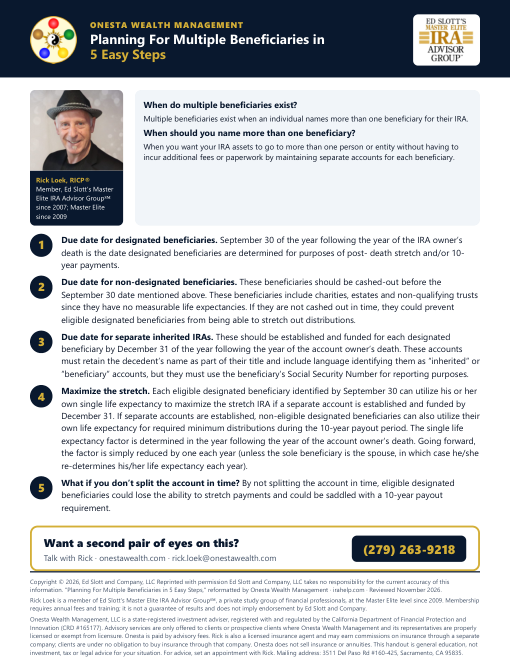
Free guide: Planning For Multiple Beneficiaries in 5 Easy Steps
For families sharing one IRA, and for owners naming more than one heir. Ed Slott's checklist, reprinted with permission.
A note on Step 4: yearly withdrawals inside the 10 years apply only if the owner died on or after their required beginning date. If the owner died before it, there are none, only the 10-year deadline. When they apply, the IRS uses the longer of the heir's life expectancy or the owner's remaining life expectancy.
Note by Onesta, checked against IRS rules, Reviewed November 2026. Ed Slott and Company did not write this note.
Copyright © 2026, Ed Slott and Company, LLC Reprinted with permission Ed Slott and Company, LLC takes no responsibility for the current accuracy of this information. "Planning For Multiple Beneficiaries in 5 Easy Steps," reformatted by Onesta Wealth Management · irahelp.com.
Questions people ask
When are IRA beneficiaries determined?
On September 30 of the year after the year of the owner's death.
What is the deadline to split an inherited IRA?
December 31 of the year after the year of the owner's death. A split by then lets each beneficiary use their own rules.
What happens if an estate is the IRA beneficiary?
If the owner died before the required start date, the account must be empty within 5 years. If after, withdrawals are spread over the owner's remaining life expectancy.
Can a trust be an IRA beneficiary?
Yes. If it meets four tests, the IRS looks through it to the people who benefit. Trusts are complicated; have a tax or legal adviser review yours.
What happens if heirs miss the December 31 split deadline?
You can still split the IRA later. Yet the yearly payout uses the whole account and the oldest heir's age. If even one heir is not in the five groups with better rules, no one gets those rules unless one heir is the owner's child under 21.
What is a conduit trust vs. an accumulation trust for an IRA?
Both can pass four IRS tests so the IRS looks through to the people named. A conduit trust pays each IRA payout straight out to those people. An accumulation trust can keep IRA funds inside the trust. Have a tax or legal pro check any trust.
Does a trustee have to send a copy of the trust to the IRA firm?
Under the final IRS rules for IRAs, a trustee does not have to send trust papers to the IRA firm. Still, your IRA firm may ask for a copy under its own rules.
How long do I have to turn down an inherited IRA?
A qualified disclaimer is due within 9 months of the owner's death under tax law. That 9-month rule holds even though the final heir list locks on September 30 of the next year. Talk to a legal or tax pro before you touch the account.
Keep reading
From the books by Rick Loek
Rick has written two books on money and retirement. They explain how he thinks about the bigger plan.
-

The Laws of Money
Unlock Wealth, Build Legacy, Transform Your Mindset · Richard Loek, 2024
#1 Best Seller in Business Education, Education Workbooks and Test Preparation, Amazon Kindle Store. Published December 2024.
Fourteen plain rules about money, one per chapter. Each chapter ends with questions to think about.
-
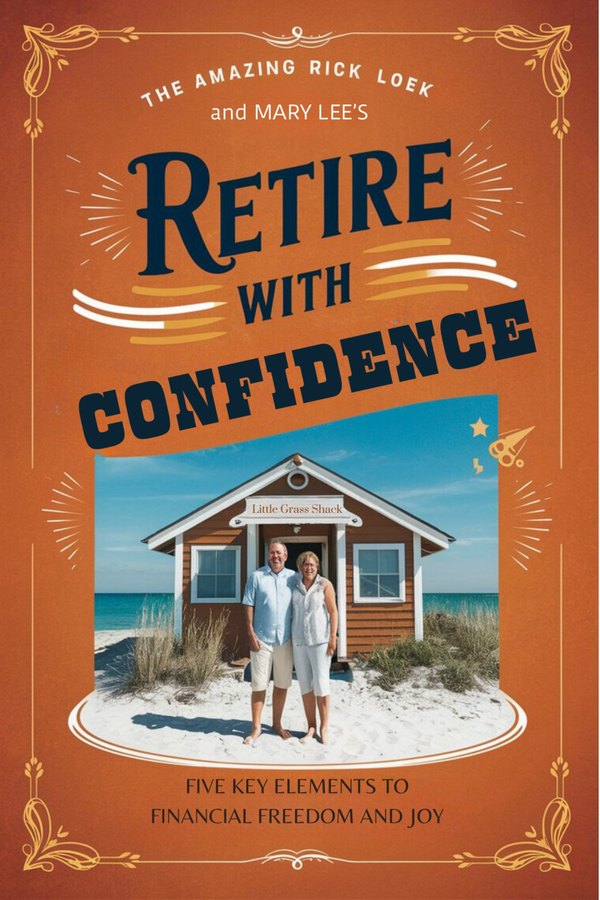
Retire with Confidence
Five Key Elements to Financial Freedom and Joy · Richard Loek and Mary Lee, 2024
#1 New Release in Retirement Planning, Taxation, and Studying & Workbooks, Amazon Kindle Store, August 2024.
The five things a retirement plan has to get right: income, risk, taxes, your estate and your investments.
See Retire with Confidence on Amazon (opens in a new tab)
Some chapters cover insurance or annuities. Onesta Wealth Management does not sell insurance or annuities. Onesta is paid only by advisory fees. Rick is also a licensed insurance agent. He may earn commissions on insurance or annuities through Calrima Senior Services and Insurance Solutions, Inc.


Want a second pair of eyes on this?
Book a 30-minute call with Rick Loek, RICP®. Bring your questions about the IRA you inherited, or the one you will leave. Rick phones you at the time you pick. Your first conversation is complimentary, with no cost and no obligation.
Book a 30-minute call (opens in a new window)Or call (279) 263-9218 · rick.loek@onestawealth.com
To be open with you: Onesta is a fiduciary for the advice we give. Onesta is paid only by advisory fees. Rick is also a licensed insurance agent and may earn commissions on insurance or annuities through a separate company. Onesta does not sell insurance or annuities. You are never required to act on our advice.