
From a parent, relative or friend
Inherited IRA rules for a non-spouse beneficiary
How you move the money matters before anything else.
The short answer
You cannot make an inherited IRA your own or roll it over. Move it only by a direct transfer between IRA companies, kept in the name of the person who died, for your benefit. Most heirs must empty it within 10 years.
Reviewed November 2026 against IRS rules. Written by Onesta from IRS sources.
"I'll cash the check and put it in my IRA." That's the costly one.
If you are not the spouse, there is no 60-day rollover. You cannot put inherited money into your own IRA, add new money to the inherited one, or roll money in or out. Once it is paid to you, it is out for good, and it is taxable that year.
What works: a direct transfer from one IRA company to another, into an inherited IRA set up in the name of the person who died, for your benefit. Your IRA company will give you the exact title it uses.
Am I in one of the five groups with better rules?
You are, if you are the owner's own child under 21, disabled, chronically ill, or not more than 10 years younger than the owner. Then you can spread withdrawals over your life expectancy. A grandchild is not a "minor child" for this rule. Check your group.
When must it be empty?
For most heirs, by December 31 of the 10th year after the death.
| Who inherited | Deadline to empty it | Yearly withdrawal in years 1 to 9? |
|---|---|---|
| Most heirs (an adult child, grandchild, sibling more than 10 years younger, friend) | December 31 of the 10th year after the death | Yes, if the owner had reached the required start date. No, if they had not. |
| Surviving spouse | No 10-year deadline | Depends on the choice the spouse makes |
| Owner's child under 21 | 10 years after the child turns 21 | Yes, life-expectancy payments |
| Disabled or chronically ill person, or someone not more than 10 years younger than the owner | No 10-year deadline for them | Yes, life-expectancy payments (some may choose the 10-year rule instead) |
| Estate, charity, or a trust that does not qualify | 5 years, if the owner died before the required start date | If the owner died after it: yearly, over the owner's remaining life expectancy |
Do I owe yearly withdrawals?
Yes, if the owner had reached their required start date: a yearly minimum in years 1 to 9. No, if they had not.
The required start date is April 1 of the year after the owner reached the age for required withdrawals: 73 for people born 1951 through 1958, and 75 for people born in 1960 or later. For people born in 1959 the IRS has proposed age 73; this is not final yet.
Work out my yearly minimumMy parent hadn't taken this year's withdrawal.
If the owner had reached the age for required withdrawals and had not taken all of that year's amount, the rest must come out by December 31 of the year of death. If you are late, the IRS waives the tax automatically if you take it by your tax-return due date for that year.
A sibling and I share it.
Split it into separate inherited IRAs by December 31 of the year after the death. Then each of you follows your own rules. If it is split later, the yearly amount is figured on the whole account. The dates for several heirs.
Did the owner have after-tax money in it?
If the owner made contributions they could not deduct, part of each withdrawal is tax-free. Form 8606 works out the split. How it is taxed.
The 5-step checklist
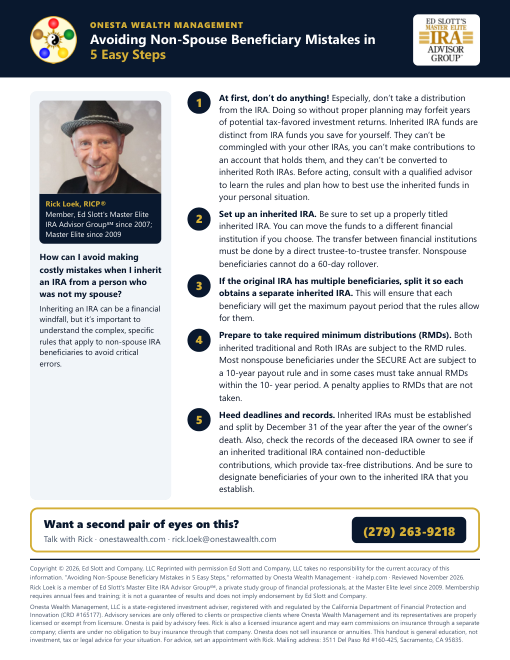
Free guide: Avoiding Non-Spouse Beneficiary Mistakes in 5 Easy Steps
For a child, grandchild, sibling or friend who inherited an IRA. Ed Slott's checklist, reprinted with permission.
A note on Step 5: December 31 of the year after death is the date to split the account so each heir uses their own schedule. You can split later, but the yearly amounts are then figured on the whole account. After-tax money in the IRA comes out partly tax-free, not wholly. IRS Form 8606 works out each part.
Note by Onesta, checked against IRS rules, Reviewed November 2026. Ed Slott and Company did not write this note.
Copyright © 2026, Ed Slott and Company, LLC Reprinted with permission Ed Slott and Company, LLC takes no responsibility for the current accuracy of this information. "Avoiding Non-Spouse Beneficiary Mistakes in 5 Easy Steps," reformatted by Onesta Wealth Management · irahelp.com.
Questions people ask
Can a non-spouse beneficiary roll over an inherited IRA?
No. A non-spouse cannot do a 60-day rollover. The money can move only by a direct transfer into an inherited IRA kept in the deceased owner's name for the beneficiary's benefit.
Do non-spouse beneficiaries have to take RMDs?
Most must empty the account within 10 years. They also take a yearly minimum in years 1 to 9 if the owner had reached their required start date.
Is a grandchild a minor child beneficiary?
No. Only the owner's own child under 21 counts as a minor child, unless the grandchild is disabled, chronically ill, or within 10 years of the owner's age.
Can I add money to an inherited IRA?
No. A non-spouse beneficiary cannot contribute to an inherited IRA.
How do I move an inherited IRA to another brokerage without owing taxes?
Ask the new firm for a direct transfer from one IRA company to the other. The new inherited IRA must stay in the name of the person who died, for your benefit (your IRA company sets the exact title). Never take a check made out to you, because non-spouse heirs cannot do a 60-day rollover.
What if my parent died before taking this year's RMD?
If your parent died on or after the required start date and had not taken all of that year's minimum, you must take the rest by December 31. If that date passes, the IRS waives the 25% tax automatically when you take the missed amount by your tax-return due date, including extensions.
Can I combine an IRA inherited from my parent with my own IRA or another relative's IRA?
No. You can never merge an inherited IRA with your own IRA or with an IRA inherited from a different person. Only IRAs of the same tax type inherited from the same person can have their yearly minimums combined.
Keep reading
From the books by Rick Loek
Rick has written two books on money and retirement. They explain how he thinks about the bigger plan.
-

The Laws of Money
Unlock Wealth, Build Legacy, Transform Your Mindset · Richard Loek, 2024
#1 Best Seller in Business Education, Education Workbooks and Test Preparation, Amazon Kindle Store. Published December 2024.
Fourteen plain rules about money, one per chapter. Each chapter ends with questions to think about.
-
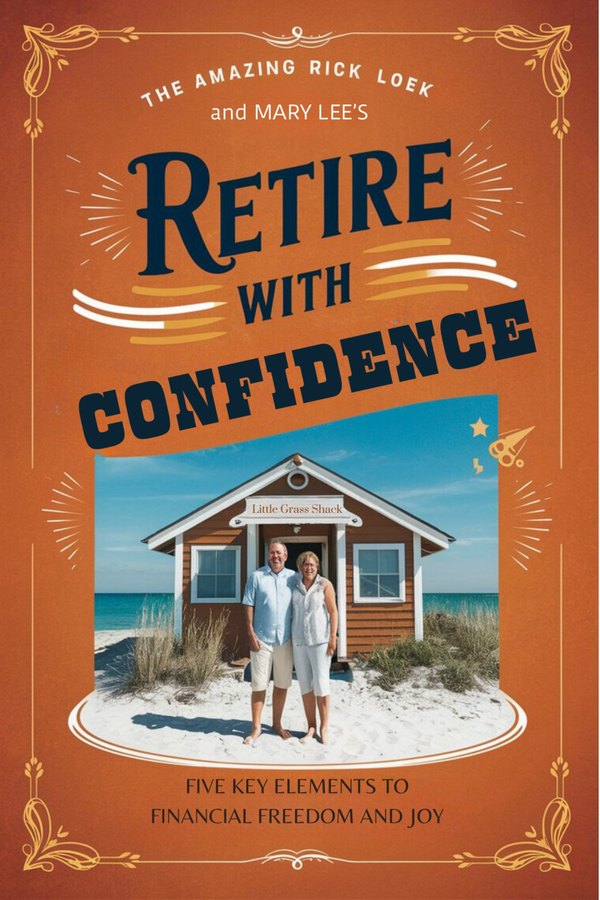
Retire with Confidence
Five Key Elements to Financial Freedom and Joy · Richard Loek and Mary Lee, 2024
#1 New Release in Retirement Planning, Taxation, and Studying & Workbooks, Amazon Kindle Store, August 2024.
The five things a retirement plan has to get right: income, risk, taxes, your estate and your investments.
See Retire with Confidence on Amazon (opens in a new tab)
Some chapters cover insurance or annuities. Onesta Wealth Management does not sell insurance or annuities. Onesta is paid only by advisory fees. Rick is also a licensed insurance agent. He may earn commissions on insurance or annuities through Calrima Senior Services and Insurance Solutions, Inc.


Want a second pair of eyes on this?
Book a 30-minute call with Rick Loek, RICP®. Bring your questions about the IRA you inherited, or the one you will leave. Rick phones you at the time you pick. Your first conversation is complimentary, with no cost and no obligation.
Book a 30-minute call (opens in a new window)Or call (279) 263-9218 · rick.loek@onestawealth.com
To be open with you: Onesta is a fiduciary for the advice we give. Onesta is paid only by advisory fees. Rick is also a licensed insurance agent and may earn commissions on insurance or annuities through a separate company. Onesta does not sell insurance or annuities. You are never required to act on our advice.